
Time management…#
is something we’ve all struggled with on and off the board. But in chess there’s nothing quite as frustrating as losing with an overwhelming advantage. Knowing you SHOULD have won if only you had more time, or simply blundering after getting into “time trouble”. It happens at all skill levels to varying degrees, and grandmasters are no exception. Their ability to play so well under the mighty hand of time is far more impressive than mine. But what is it that world champion chess players have that us mere mortals do not? Are they more efficient thinkers? Do they practice Wim Hof in ice baths while reciting opening lines to remain cool under pressure? Do they chug 19 liters of coffee before their bullet matches to get that sub 6 millisecond twitch? In reality it’s probably all of the above, but I’m here to elucidate that elusive and slippery thing known as time by shedding a little bit of light on the subject.
Why is it so hard to master?#
Time is not something you can see, and I suspect that is a big part of it, but in chess there are many additional variables that make simply grasping the problem difficult. Forget mastering it. For GMs and the like, time management appears to be a gift or something that only comes about with decades of experience. It is to some extent, but what all those years of experience offer a grandmaster is something not even they can oftentimes articulate. At this point you might think, is it even possible to quantify the variables involved in time management? Is this something I should waste my time on trying to understand? Can this article help me improve my game? Well, the answer is yes and maybe…
Here is the Truth:#
Time management in chess boils down to talent, training, experience, and chess knowledge (think opening, endgame and positional knowledge). For example it makes sense that if you know opening theory you can basically premove the first 15 moves, thereby not wasting a millisecond of time. Same thing goes for endgames. The middlegame can be understood by realizing that your ability to assess a position and calculate determines how efficient you are with your time. The wildcard is stress, which can magically undo all your chess knowledge, and this is where training and even physical fitness can come into play. Physical factors can absolutely affect how one manages time. I can’t help but think that Magnus Carlsen being an avid soccer player contributes in some way to his performance over the board. The body is a finely tuned machine after all. So the obvious ways to improve your time management are always going to be “study openings”, “study endgames”, “study chess theory”, and “play a lot of chess”. But the world of chess needs a more focused training regime for time management. The problem is that it’s traditionally a difficult thing to track. How do you know you’re managing your time well?
To save you the suffering#
I downloaded Lichess’s entire public game database, every month from 2017 to September 2025, amassing over 7 BILLION games to poke and prod with the goal of tickling some tantalizing time management tidbits for y’all. For the record that’s almost 5 terabytes of data. My ISP is hating me right now.
Now, I didn’t look at all seven billion. I only kept the games that actually test time management: rated, no increment, played between January 2023 and September 2025. 1+0, 2+0, 3+0, 5+0, 10+0, 15+0. No time added back, ever. You get your budget and that’s it. Bots are out. Berserkers are out. Anyone who got gifted extra time by their opponent is out. That still leaves about 70 million player-games from the rating ladder, plus every game played by a titled account in 2024 and 2025 (another 14 million) so the grandmaster numbers aren’t built on a handful of games.
Here’s how it works. Lichess stamps your remaining clock after every single move. Your clock only runs on your turn, so the drop from one of your moves to the next is exactly how long you sat there thinking. 2:59, 2:52, 2:51. Seven seconds on that move. One on the next. That’s the whole trick.
The question I got wrong#
Before I show you anything, answer this honestly. A grandmaster and a 1200 each play a three minute game. Who plays at the steadier, more consistent pace?
I said the grandmaster. Calm, collected, nice even rhythm, never panicking. That’s what good time management looks like, right?
Wrong. It’s the other way around. And not by a little.
Surprise #1: Grandmasters don’t play faster#
First thing I checked: do strong players just move quicker? Nope.
In 3+0 blitz an 800-rated player averages about 4.3 seconds a move. A 1200, about 3.6. A grandmaster? 3.3. From 1200 all the way to GM the difference is about a quarter of a second per move. Basically nothing.
So if you’ve been told your problem is that you play too slow… maybe. But raw speed is not what separates you from a GM. Plenty of popular advice says to aim for about five seconds a move in 3+0. Every rating group on Lichess already averages under five. There’s no pace gap to fix.
Surprise #2: Grandmasters have the least steady pace#
I measured how uneven every player’s pace is inside a single game. Not how fast, how lumpy. To keep it fair I compared each move to that player’s own average for that game, so a slow player and a fast player land on the same scale (statisticians call this the coefficient of variation).
For an 800, a typical move is about 86% off their own average. Go up the ladder and that number goes up. Every single step. By 2600+ it’s 126%. Grandmasters sit at 120%.
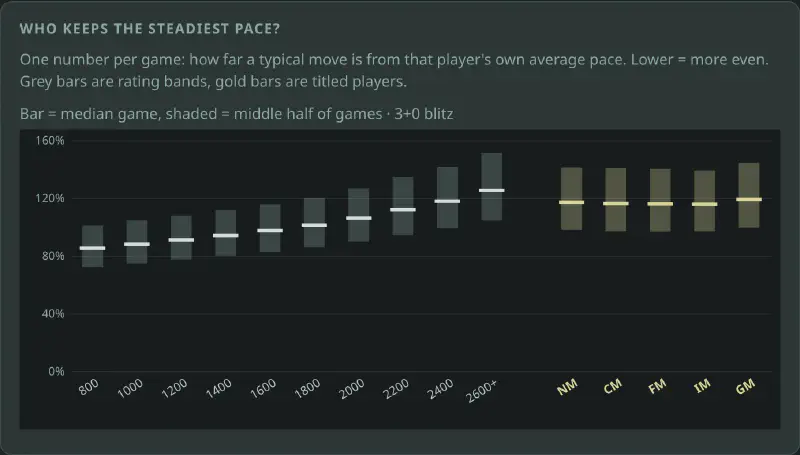
Same story in bullet. Same story in rapid. The best players in the world have the least consistent rhythm.
When I saw that I assumed I’d screwed something up. So I tried to break it (3+0, typical game, players under 1200 vs grandmasters, games that reach move 31):
- “GMs just premove their opening theory.” Fine, I threw away the first ten moves. Still 85% vs 116%.
- “It’s premoves.” Threw away every move under a second too. Still 80% vs 103%.
- “A couple of giant thinks are skewing it.” Used a measure that ignores outliers. Still goes up.
- “Strong players’ games are just longer.” Middlegame only. Still 77% vs 99%.
It’s real. And it’s not even new. A team in Buenos Aires spotted the start of this back in 2010 with about 91,000 games1. I just threw about a thousand times more at it. One honest caveat: in 1+0 bullet the gap disappears once you remove moves under a second. In bullet, the GM difference is almost entirely instant moves.
So what are they actually doing?#
Picture your three minutes as a stack of 180 poker chips.
A 1200 spends it like a guy feeding a parking meter. Three chips, three chips, four chips, three chips. Every move. Whether the move matters or not.
A grandmaster spends it like a poker player. One chip. Zero. One. Zero. Zero… then shoves a whole pile on the one move that decides the game.
Same total. Totally different shape. GMs aren’t managing a pace. They’re managing a budget, and they know which moves are worth buying.
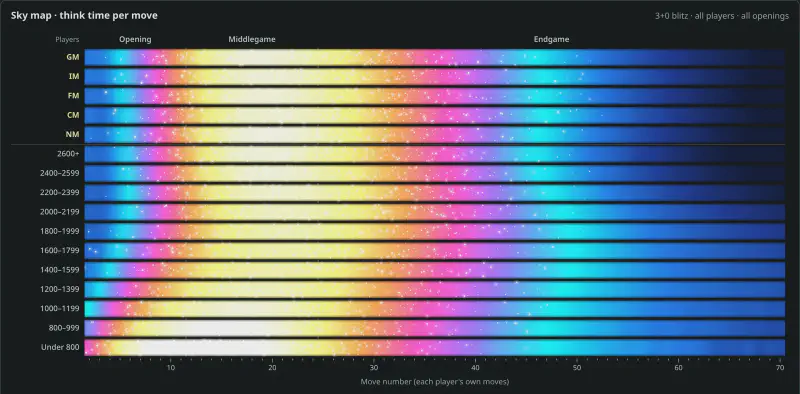
Here’s the whole rating ladder in one picture. Each row is a group of players, left to right is the game, and colour is how long the average move takes. Blue is quick, white-hot is a long think. The white specks are big thinks (5% of the clock or more on one move).
And here’s every rating band compared with grandmasters directly. Orange means that band thinks longer than GMs at that point in the game, blue means GMs think longer:
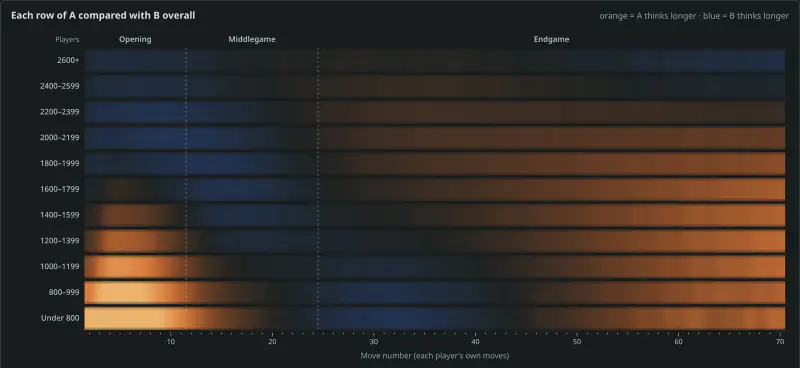
Read it left to right. Weaker players burn their clock in the opening. Grandmasters out-think everyone in the middlegame. Then in the late endgame most bands are spending more than GMs, because by then GMs are converting on autopilot while everyone else is scrambling.
Where the chips go#
Split the game where the typical Lichess game does: the opening runs to about your 11th move, the middlegame to about move 24, the endgame after that. Then add up where each group’s thinking time goes.
In 3+0 blitz, players rated 1200 to 1399 spend 25% of their thinking time in the opening, 47% in the middlegame and 28% in the endgame. Grandmasters spend 17%, 47% and 36%. Under 1000 it’s a full third in the opening.
Twelve hundreds burn a quarter of their thinking time before the game has even started. GMs bank that and spend it in the endgame, where games actually get decided. If you take one number away from this article take this one: roughly 16% opening, 46% middlegame, 38% endgame. That’s what players rated 2000+ do in blitz, across millions of games. You’ll see “spend 5% on the opening and 80 to 90% on the middlegame” floating around. Strong players don’t do that. Not even close.
But are the big thinks on the right moves?#
“Spend time on the important moves” is lovely advice if you can tell which moves are important. Can GMs? Or are they just lumpy for the heck of it?
This one I’m not going to pretend I discovered. Researchers at Princeton ran 12.5 million Lichess games through Stockfish and measured, position by position, how much extra thinking would actually have paid off. Players think longer exactly where thinking pays off, and the stronger the player, the tighter that link2. In other words the lumpiness isn’t random. It’s aimed.
That’s the actual skill. Not speed. Not calm. Knowing when. GM Daniel Naroditsky famously timed Hikaru Nakamura through three blitz games and found he spent 10+ seconds on only a handful of moves3. Our grandmasters average about one think of 10% of the clock or more per 3+0 game. Same pattern, three games vs hundreds of thousands.
The plot twist: bullet#
In 3+0 and 10+0, strong players take more big thinks than amateurs. In 1+0 it flips. Grandmasters take fewer long thinks than 1200s and they lose on time about half as often: 16% of games vs 33%.
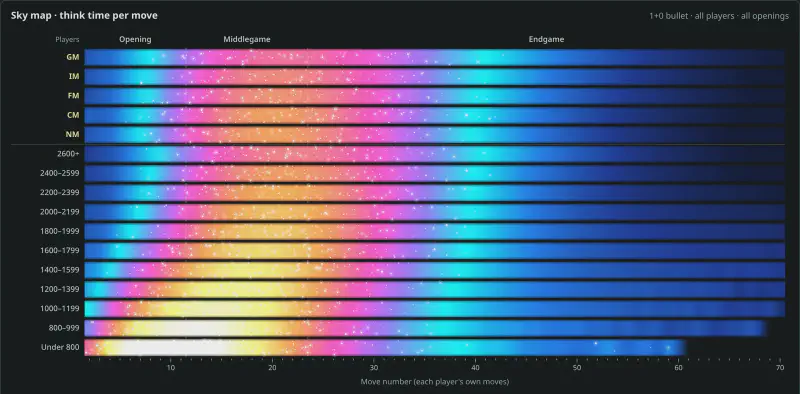
In bullet there’s no budget to spend. The skill is refusing to think. Which means a whole lot of the time management advice floating around is right for blitz and dead wrong for bullet.
How to improve your time management#
Six rules. That’s it.
- Buy your opening cheap. If more than about a fifth of your thinking time goes into your first ten moves, play something you actually know. Sharp gambits are fun. They’re also expensive.
- Find the moves worth buying. A pawn break. A capture that changes the pawn structure. A king move. A sacrifice, yours or his. The move right after your opponent surprises you. That’s where the chips go.
- In blitz and rapid, take at least one real think a game. GMs do it about once per 3+0 game. A lot of club players never do it at all, they just bleed three seconds at a time.
- Keep an endgame reserve. Strong players spend over a third of their thinking time after move 25. If you hit the endgame with 15 seconds you’ve already lost the budget fight.
- In bullet, don’t. Premove forced recaptures. Play the first good move. Thinking is for blitz.
- Measure, don’t guess. Time is invisible while you play. Look at your own clock numbers after the fact, compare them with players you want to beat, and check again in a month.
Check your own clock#
I built two things while doing all this and they’re free.
The Chess Clock Map is the whole dataset. Pick your rating, your time control, your opening, and see how people like you spend their clock vs grandmasters. Compare any two groups, or overlay individual titled players.
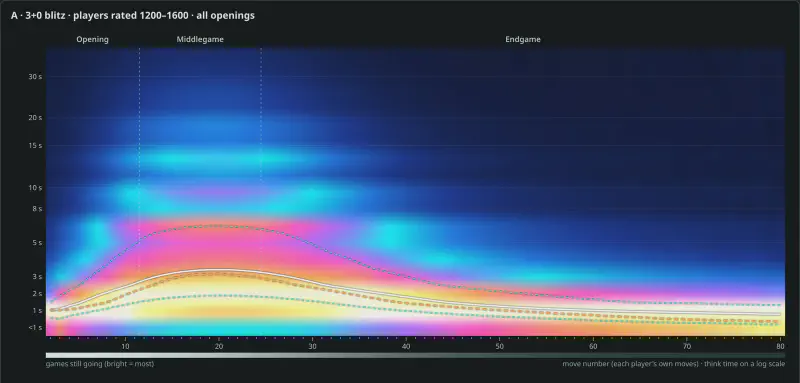
The Chess Clock Tracker takes your Lichess or Chess.com username and lines your own spending pattern up against whoever you want to become: grandmasters, a rating band, or a specific player. Hikaru, if you hate yourself. It grades your average pace, evenness, clock left and time losses, breaks them down by opening, and saves snapshots so you can see if you’re actually closing the gap.

Get the Chess Clock Tracker free
Enter your email and we'll send you a private link to the member tools: the tracker, the Player Archive Downloader and more. No password, no spam, unsubscribe anytime.
FAQ#
How much time should I spend per move in chess? There’s no magic number. In 3+0 blitz the average move takes about 3.3 to 3.6 seconds at every level from 1200 to GM. What matters is the shape: near zero on routine moves, 10 to 20 seconds on the few that change the game.
How much time should I spend in the opening? Strong players spend about 16 to 17% of their thinking time on their first ten or so moves in blitz. Club players spend about a quarter, beginners about a third.
Why do I keep getting into time trouble? Usually not because you’re slow, but because you’re even: you pay a few seconds on every move, including the ones that don’t need it, so there’s nothing left when the position finally gets hard.
How do I stop losing on time in bullet? Think less. Titled players lose on time in about 16% of 1+0 games, club players in about a third, and the difference is almost entirely instant moves.
Is this data from Lichess or Chess.com? Lichess, because Lichess publishes every game with clock times under a public-domain license. Chess.com and Lichess ratings sit on different scales, so when you compare Chess.com games with this data, compare against a title group or a specific player.
How this was measured#
- Data: Lichess open database (CC0), rated standard games with no increment, January 2023 to September 2025. Rating bands use a uniform sample of every month (about 70 million player-games across the six time controls). Titled players use every game by a titled account in 2024 and 2025 (about 14 million player-games).
- Think time is your own clock drop between your consecutive moves. Lichess stores whole seconds. Move 1 is untimed. Bots, berserked games and games with time added are excluded.
- Unevenness is the standard deviation of a game’s think times divided by its average, for games with at least 10 timed moves; the robustness checks above use the median game per group.
- Phases follow a simplified version of Lichess’s own material-based divider; the median middlegame starts at move 12 and the endgame at move 25 in every time control.
- Big think = a single move using 5% of the starting clock or more (10% in the per-game counts).
- Everything is explorable on the Chess Clock Map, under “Method and data”.
Well that’s it. Go spend your clock like it’s money, because it is. And if your tracker says you’re a parking meter… I’ve almost always got your back, kiddo ;)
Sigman, Etchemendy, Fernández Slezak & Cecchi (2010). Response time distributions in rapid chess: a large-scale decision making experiment. Frontiers in Neuroscience 4:60. doi:10.3389/fnins.2010.00060 ↩︎
Russek, Acosta-Kane, van Opheusden, Mattar & Griffiths (2025). Time spent thinking in online chess reflects the value of computation. Cognitive Science 49(10), e70119. doi:10.1111/cogs.70119 ↩︎
Daniel Naroditsky, The Art of Time Management, chess.com. ↩︎